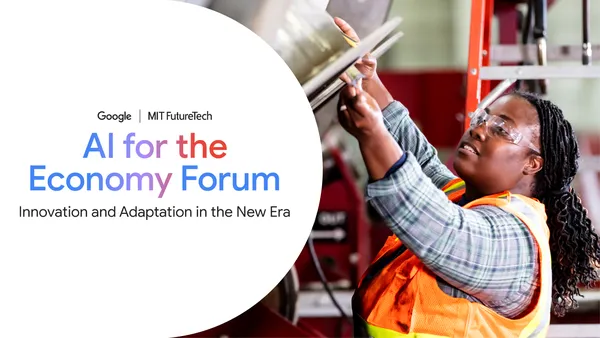

Google and MIT FutureTech just wrapped their first AI for the Economy Forum in Washington D.C., and the big takeaway is that they’re putting real money behind the conversation. Not just talk about how AI might change jobs and the economy, but actual investments in research and training.
The event itself was a gathering of economists, industry folks, policymakers, and researchers. The premise is refreshingly honest: neither the benefits nor the risks of AI are automatic. We as a society actually get to shape how this plays out. That’s not a given with most technological shifts.
Research money where the mouth is
Google’s new AI & Economy Research Program is the headline here. They’re funding external researchers through a Visiting Fellows program, starting with MIT’s David Autor, who’s been doing solid work on how technology affects labor markets for years. They’re also expanding their Digital Futures Project, which already backed research from MIT’s Ben Armstrong and Julia Shah on how firms can deploy AI in ways that actually benefit workers.
That last bit is worth pausing on. Armstrong and Shah found that the most successful AI deployments minimize drudgery, promote learning, and foster collaboration. Shocking, right? Yet so many companies still treat AI as a cost-cutting hammer rather than a tool for augmentation. Maybe this research will nudge them.
Google.org is also funding a global cohort of research institutions to study AI’s impact on labor markets, sector-specific transformations in manufacturing and healthcare, and the policy environments needed to maximize workforce opportunity. They’re even expanding internal research on generative AI’s real-world impact on knowledge-worker productivity and the economics of AI agents.
To guide this work, they’ve lined up an advisory board that includes Nobel Laureate Michael Spence, Cambridge’s Dame Diane Coyle, and former PIMCO CEO Mohamed El-Erian. That’s not a bad brain trust.
Training for the real world
The other big announcement is about training. Google’s committing to programs that help workers actually prepare for what’s coming. They mention funding for healthcare worker training and apprenticeships in high-demand fields. This is higher than I expected from a corporate AI event, honestly.
We’ve seen this playbook before with previous technological shifts, and the results have been mixed. But Google’s scale means even small per-capita investments can move the needle. The key will be whether these programs reach people who aren’t already in tech or adjacent fields. Apprenticeships in manufacturing and healthcare sound promising if they’re structured right.
What I’m watching
I’m skeptical of any single company’s ability to “shape” AI’s economic impact, but Google’s approach here is more thoughtful than most. Funding independent research and training programs is a bet on ecosystem development rather than just their own bottom line. That’s rare.
The real test will come in a few years when we can see whether this research actually influenced policy or corporate behavior, and whether those training programs produced measurable outcomes. For now, it’s a solid start.
One thing I wish they’d addressed more directly: the distributional effects. AI will likely concentrate gains even further if left unchecked. Research on that would be more valuable than yet another study on productivity gains. Maybe that’s in the pipeline.
Comments (0)
Login Log in to comment.
Be the first to comment!