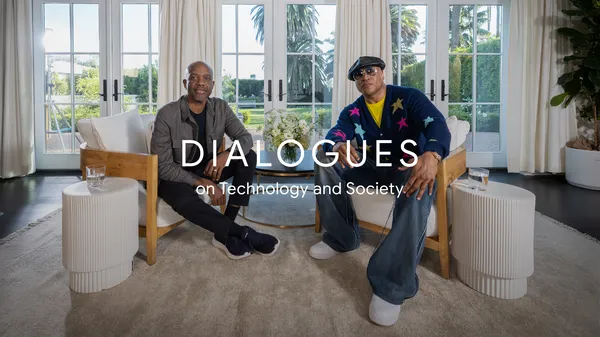

I’ve been watching Google’s Dialogues on Technology and Society series for a while now, and the latest episode caught me off guard. They sat LL COOL J down with James Manyika, Google’s SVP of Research, Technology & Society. Yes, that LL COOL J—the Rock & Roll Hall of Famer, the guy who made “Mama Said Knock You Out” a cultural anthem.
And it wasn’t a gimmick. It was actually good.
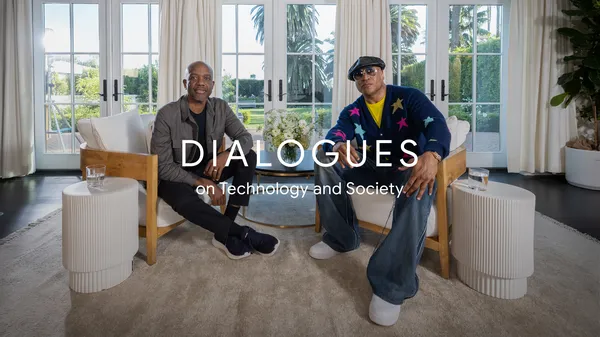
The thumbnail alone tells you this isn’t your typical tech panel. You’ve got a hip-hop icon in a leather jacket sitting across from a guy in a blazer who runs a massive chunk of Google’s research arm. The dynamic works because neither side is pretending.
What They Actually Talked About
Most AI-and-creativity conversations are painfully abstract. Someone from a lab talks about “generative models” and “latent spaces” while a musician nods politely. This one was different. LL COOL J brought his own experience—he’s been in the studio for four decades, seen sampling wars, digital distribution, and now generative AI. He’s not a tourist in this conversation.
Manyika, to his credit, didn’t dodge the hard questions. They got into the tension between AI as a tool versus AI as a replacement. LL COOL J made the point that creativity has always been about human expression, not just technical output. That sounds obvious, but in an era where people are churning out AI-generated tracks on SoundCloud, it’s worth repeating.
The Parts That Stood Out
There’s a moment where they discuss how AI could actually help preserve cultural heritage—archiving dialects, recording oral histories, reconstructing damaged recordings. That’s the kind of application that doesn’t make headlines but matters deeply. LL COOL J pushed back on the idea that AI just “democratizes” creativity, pointing out that access to tools isn’t the same as access to opportunity. Fair point.
They also touched on bias in AI systems. Manyika acknowledged that models trained on historical data can encode the same prejudices we’re trying to move past. LL COOL J framed it in terms of representation: if the training data doesn’t include enough voices from certain communities, the outputs will reflect that silence. That’s not a technical problem—it’s a cultural one.
What’s Missing Here
Look, I’m not going to pretend this conversation solved anything. It’s a 20-minute dialogue, not a policy paper. But what I appreciated was the lack of corporate gloss. Manyika didn’t try to sell me on Google’s latest AI product. LL COOL J didn’t pretend to be a technologist. They just talked.
If you’re tired of AI coverage that oscillates between utopian hype and dystopian panic, this is a refreshing middle ground. Two smart people, one microphone, no slides. Give it a watch.
Comments (0)
Login Log in to comment.
Be the first to comment!