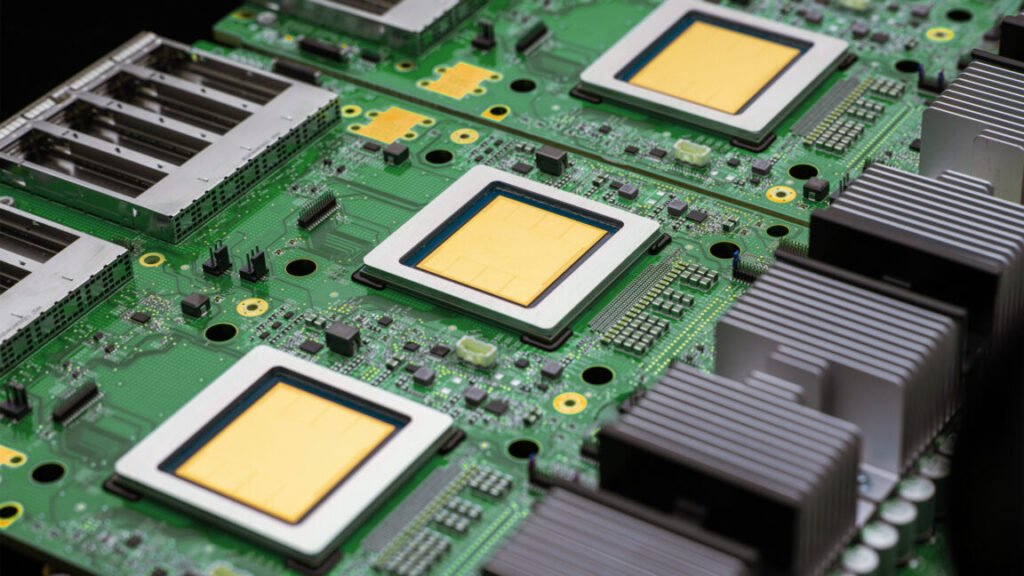

Most big AI players are still hoovering up every Nvidia accelerator they can get their hands on. Google, as usual, is doing its own thing.
Instead of just waiting in line for H100s or B200s, Google has been quietly building its own custom Tensor Processing Units (TPUs) for years. The seventh-gen Ironwood came out in 2025, and now they’re already moving to the eighth generation. But this isn’t just a faster, shinier version of the same chip.
Google is splitting the new TPU lineup into two distinct flavors: the TPU8t for training and the TPU8i for inference. The company’s argument is that we’ve entered what they call the “agentic era”—where AI systems don’t just answer questions but take actions, make decisions, and operate more autonomously. That shift, they claim, demands a fundamentally different hardware strategy.
I’m not entirely sold on the “agent era” branding—feels like another buzzword Google is trying to make stick—but the hardware split itself makes a lot of sense. Training and inference have very different workloads. Training is about raw throughput, shoving mountains of data through massive models over weeks or months. Inference is about latency, getting a single response back in milliseconds. Trying to optimize one chip for both is a compromise.
The TPU8t is the brute-force training monster. Google says it can shrink training time for frontier models from months down to weeks. That’s not just a nice-to-have; it’s a competitive necessity when your rivals are also iterating at breakneck speed. If you can train a model in three weeks instead of three months, you can experiment more, fail faster, and ship sooner.
The TPU8i, on the other hand, is built for inference—the part where the trained model actually runs in production, answering queries, generating images, or powering those “agentic” workflows Google keeps talking about. Inference efficiency matters because it’s where the ongoing costs live. Train once, infer forever.
Google’s approach isn’t new territory for the industry. We’ve seen dedicated inference chips before—Groq’s LPU, Amazon’s Inferentia, even some of Nvidia’s own T4 and L4 GPUs. But Google is betting big that the future of AI will be heterogeneous: different chips for different jobs, all tied together by its cloud infrastructure.
What I find interesting is the timing. Google is launching these right as the industry is starting to question whether the massive training runs we’ve seen are sustainable. If agentic AI really does take off, inference demand could explode—every query, every action, every decision requires a model call. That’s where the TPU8i could shine.
Will it be enough to dent Nvidia’s dominance? Probably not overnight. But Google doesn’t need to win the chip war; they just need to make their cloud platform compelling enough that you don’t feel the need to go elsewhere. With these two new TPUs, they’re making a clear pitch: come to Google Cloud, and we’ll give you the right tool for the job, not a one-size-fits-all compromise.
I’ll be curious to see real-world benchmarks when they drop. Until then, this is a smart move from a company that’s been playing the long game in AI hardware since before “AI” was the only thing anyone talked about.
Comments (0)
Login Log in to comment.
Be the first to comment!