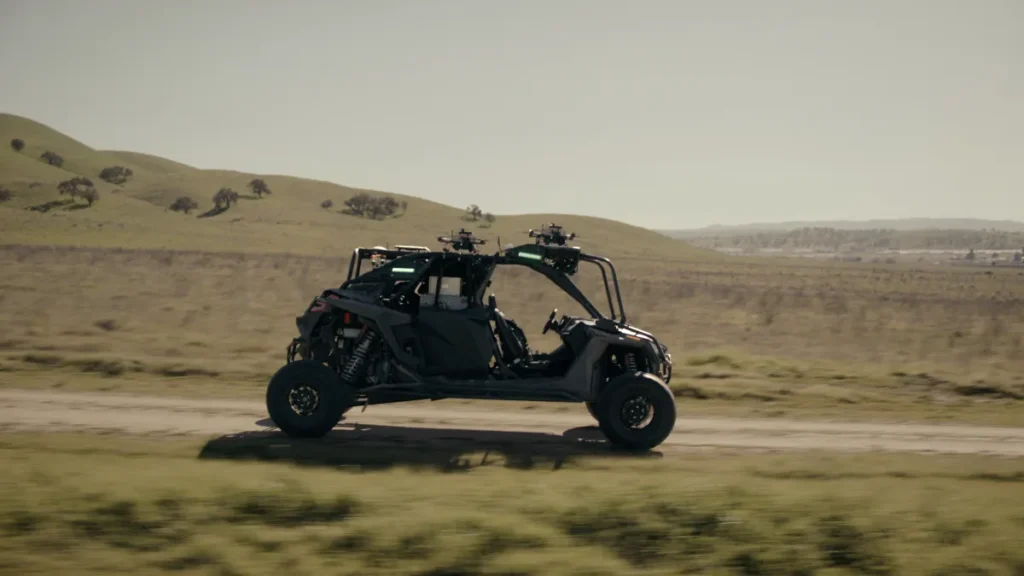

Colby Adcock’s Scout AI just closed a $100M round to keep building what might be the most unsettling — and maybe necessary — military AI I’ve seen in a while. The pitch is simple: one soldier, one tablet, and an AI that handles the chaos of coordinating dozens of autonomous vehicles in real time.
I went to their training ground, which they call a bootcamp, and it’s not what I expected. No rows of servers humming in a data center. No VR headsets. Just a dusty field, some modified commercial drones, a handful of ground robots, and a lot of people staring at screens.
The core idea is that current military drone operations are still too human-intensive. Each UAV needs a dedicated operator, and that scales terribly when you’re trying to field a swarm. Scout’s approach is to put an AI layer between the soldier and the fleet. The human gives high-level intent — “secure that hill,” “patrol this perimeter” — and the AI figures out which vehicle goes where, when to loiter, when to return, and how to react if comms drop.
I watched a demo where a single operator controlled three drones and two ground bots simultaneously. The operator drew a box on a map, tapped “search,” and the AI split the area into sectors, assigned vehicles, and adjusted their paths in real time as terrain data came in. No manual waypoint plotting. No constant micro-management. It worked smoothly, which is more than I can say for most enterprise AI demos I’ve sat through.
Adcock told me the $100M will go toward expanding the model’s training data — specifically, more real-world edge cases. Bad weather. Electronic warfare jamming. GPS denial. The kind of stuff that breaks most autonomous systems. They’re collecting field data from military exercises and supplementing it with synthetic environments. That part is smart: you can’t just throw more compute at this problem. You need the right failure scenarios.
There’s a tension here that’s hard to ignore. Scout’s tech is clearly designed for lethal applications. The company doesn’t hide that — they’re working with the Department of Defense, and the use case is combat. But the technical challenge is genuinely interesting. Most AI agents fall apart the second the environment changes even slightly. Scout is trying to build agents that can handle the messiness of real battlefields: dust, smoke, radio interference, sudden orders, friendly fire avoidance.
I asked about the ethical boundaries. Adcock was direct: the AI doesn’t pull triggers. It handles navigation, coordination, and sensor fusion. The human stays in the loop for any kinetic decision. That’s the line they’re drawing, and for now it’s the right one. But the tech could easily evolve, and the $100M gives them runway to push that boundary if the customer asks for it.
The bootcamp itself was revealing. They run live exercises every few weeks with actual military personnel, not just engineers. Soldiers break the system in ways the dev team never anticipated. Lost line of sight, bad battery swaps, accidental radio interference from other units. Each session generates data that goes back into the training pipeline. It’s iterative, ugly, and probably more effective than any simulation.
What struck me most was how unglamorous it all looked. No sleek control rooms. No holographic maps. Just a guy in a tent with a ruggedized tablet, swiping through a UI that looked like a cross between a strategy game and a fleet management dashboard. The AI’s decisions showed up as suggested waypoints and timing adjustments. The operator could accept, modify, or override. That’s the interaction model, and it works because it doesn’t pretend the AI knows everything.
Scout’s competitors are mostly defense primes and university labs. The primes move slow and over-engineer. The labs publish papers but don’t ship. Scout sits in the middle — small enough to iterate fast, funded enough to buy hardware and pay for field time. The $100M gives them a real shot at becoming the default OS for small-unit drone operations.
The obvious risk is that the military’s procurement cycle will grind them down. But Adcock seems aware of that. He’s hiring people who have actually served, not just AI researchers. That’s a signal that they’re building for real constraints, not just pushing a model card.
I left the bootcamp with mixed feelings. The tech is impressive. The approach is pragmatic. But the domain is war, and no amount of clean UI changes that. If you’re going to build military AI, this is probably the right way to do it — tight human oversight, real-world training, and a clear scope. Whether that’s enough is a question nobody in that tent could answer.
Comments (0)
Login Log in to comment.
Be the first to comment!