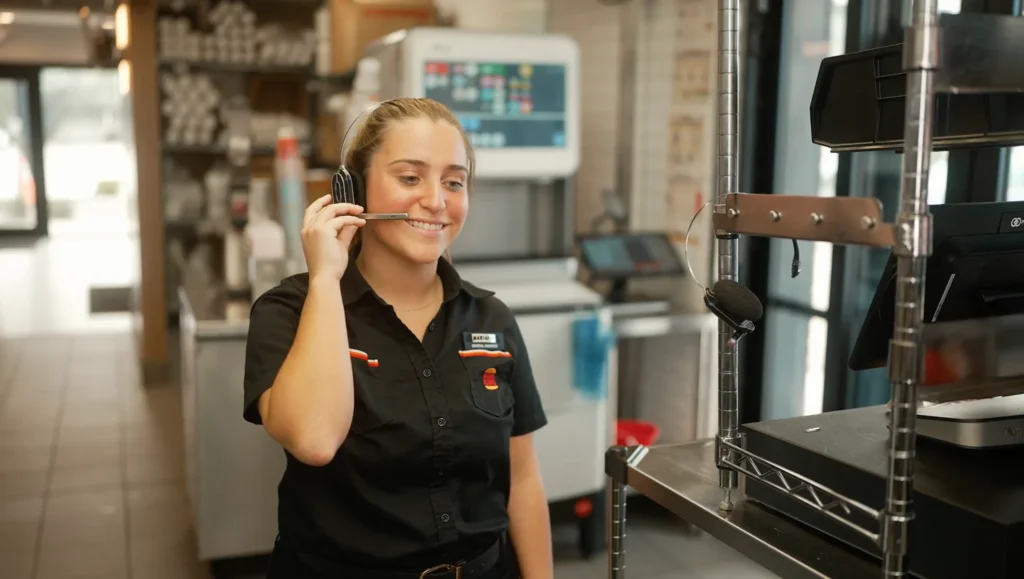

Burger King is putting an AI chatbot called Patty into the headsets of its employees. But this isn’t just another drive-thru voice assistant that takes orders and gets them wrong half the time. Patty is there to help with meal prep, sure, but it’s also there to judge whether workers are being polite enough.
The company’s chief digital officer, Thibault Roux, told The Verge that the AI is trained to recognize specific phrases like “welcome to Burger King,” “please,” and “thank you.” Managers can ask Patty how their location is doing on “friendliness.” Roux insists this is meant as a coaching tool, not a surveillance system. They’re also working on capturing tone of conversation, which sounds like a whole other can of worms.
Patty runs on OpenAI’s tech and serves as the voice for the broader BK Assistant platform. That platform pulls in data from drive-thru conversations, kitchen equipment, inventory, and other parts of the business. Employees can ask Patty practical questions like how many strips of bacon go on a Maple Bourbon BBQ Whopper, or how to clean the shake machine. That part actually seems useful.
Because Patty is tied into the new cloud point-of-sale system, it can also alert managers when a machine is down or when something is out of stock. Roux says the system can update digital menu boards, kiosks, and drive-thru displays within 15 minutes of a stock change. That’s faster than a human could probably manage.
But here’s the thing: Burger King isn’t rushing to put AI in the drive-thru lane itself. While McDonald’s, Wendy’s, and Taco Bell have all experimented with AI taking orders directly from customers, Roux admits that’s still a risky bet. “Not every guest is ready for this,” he said. They’re testing AI drive-thru tech in fewer than 100 restaurants for now.
BK Assistant is supposed to roll out to all US restaurants by the end of 2026. Patty is currently piloting in 500 locations. That’s a decent-sized test, but it’s still a pilot.
I get the appeal of using AI to help employees do their jobs better. A quick answer on how many bacon strips to use or a heads-up that the shake machine is busted can save time and frustration. But using the same system to monitor whether someone said “please” feels like a step too far. It’s one thing to coach employees on customer service. It’s another to have an AI chatbot tattling to managers about missed pleasantries.
The tone detection piece is particularly concerning. I’ve seen enough AI tone analysis tools fail miserably to know this is going to be a mess. Accents, sarcasm, genuine frustration with a broken milkshake machine — the AI won’t understand any of that context. It’ll just flag a worker as “unfriendly” because they sounded tired after an eight-hour shift.
Burger King seems to be positioning this as a helpful assistant first and a monitor second. But once the system is in place, it’s hard to imagine managers not using the friendliness data as a performance metric. And nobody wants to get written up because an AI decided they didn’t sound cheerful enough while asking if someone wants fries with that.
Comments (0)
Login Log in to comment.
Be the first to comment!