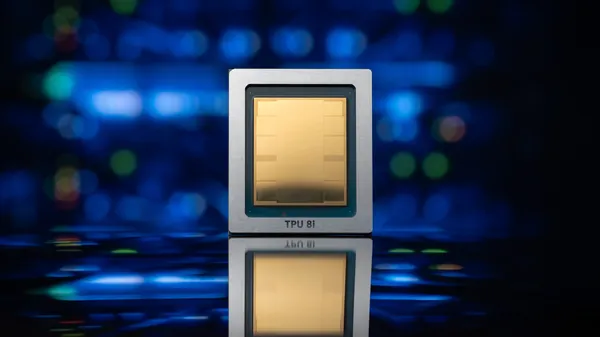

You probably don’t think about the hardware behind your Google searches, Gmail autocomplete, or YouTube recommendations. But there’s a custom chip doing the heavy lifting: the TPU, or Tensor Processing Unit.
Google designed these from scratch more than ten years ago, and they’ve been iterating ever since. The idea was simple — AI models need a ridiculous amount of matrix math, and general-purpose CPUs or even GPUs weren’t cutting it for the scale Google needed. So they built their own.
The latest generation is a monster. We’re talking 121 exaflops of compute, with double the memory bandwidth of the previous generation. For context, an exaflop is a quintillion floating-point operations per second. That’s not a typo.
What does that actually mean for the models running on them? Faster training times, obviously. But more importantly, it means you can run larger, more complex models without waiting forever. Think massive language models, real-time translation, or image generation that doesn’t feel like watching paint dry.
Google’s TPUs have been powering internal workloads for years, but they also make them available through Google Cloud. So if you’re training a model at scale and don’t want to deal with GPU cluster drama, it’s a solid option — assuming you’re okay with being locked into Google’s ecosystem.
One thing I appreciate about the TPU approach: they didn’t try to make a general-purpose chip. It’s purpose-built for TensorFlow and similar frameworks. That means less overhead, more raw performance for the specific math AI needs. The trade-off? You can’t just throw any workload at them and expect magic. But for the jobs they’re designed for, they’re hard to beat.
There’s a video embedded in the original post showing the physical chips and some performance demos. Worth a watch if you’re into hardware porn — those things are surprisingly compact for what they do.
I’ve been watching TPU generations roll out since the first one in 2015. Each iteration has been a meaningful jump, not just marketing fluff. The bandwidth doubling this time is particularly interesting because memory bandwidth is often the bottleneck for large models. More bandwidth means less time waiting for data to move around, which translates directly to faster iteration cycles.
If you’re doing serious AI work at scale, it’s worth keeping an eye on what Google ships. They don’t talk about TPUs often, but when they do, the numbers are usually impressive.
Comments (0)
Login Log in to comment.
Be the first to comment!