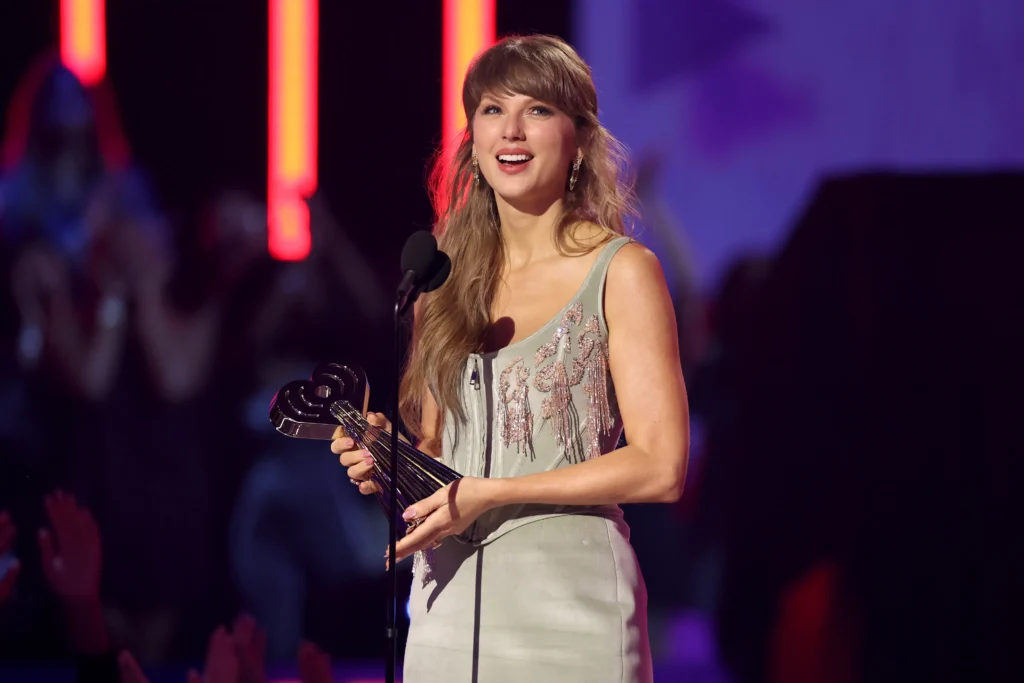

Taylor Swift has been dealing with AI copycats for years now. Deepfake songs, fake endorsements, voice clones — you name it, someone’s tried to make a buck off her likeness without permission. Her latest move? Trying to trademark two specific phrases: “Hey, it’s Taylor Swift” and “Hey, it’s Taylor.”
Her team filed the applications through TAS Rights Management last week, attaching audio clips of Swift actually saying those lines during a promo for her latest album. The logic is straightforward: if someone else generates an AI version of her voice saying those exact words, the trademark could be used to shut it down.
It’s a clever angle, I’ll give them that. Trademark law is about protecting brand identity, and Swift’s voice — her actual recorded voice saying her own name — is about as personal a brand marker as you can get. But the legal system moves slowly, and AI moves fast. The bigger question is whether this strategy actually holds up in court.
Trademarks are typically tied to goods or services. You trademark a phrase used to sell a product, not a phrase you just say sometimes. The applications will need to prove that these two phrases function as a source identifier — that hearing “Hey, it’s Taylor” immediately tells you this is an official Swift communication, not just anyone talking. That’s a harder sell than it sounds.
And even if the trademark gets approved, enforcement is another headache. AI-generated content doesn’t always come with a clear defendant. It could be a random user on a platform based in another country, or a service that generates the audio on the fly. Sueing every instance isn’t practical.
Still, I don’t think this is a waste of time. Filing these trademarks sends a signal. It puts other companies on notice that Swift’s team is watching and willing to use whatever tools they have. It also builds a paper trail that could be useful in future legislation or litigation. Sometimes legal strategy isn’t about winning one case — it’s about setting up the battlefield for the next fight.
What I find interesting is that Swift’s approach here is more targeted than the blanket “no AI training on my voice” demands some artists have made. She’s going after the specific moment of impersonation — the greeting, the introduction — rather than trying to ban all synthetic voice generation. That’s pragmatic. It’s also a tacit admission that you can’t realistically stop all AI mimicry, so you pick the most commercially damaging use cases.
The Verge notes that this is a long shot. I’d agree. But long shots sometimes pay off when you have the resources to keep pushing. Swift’s legal team has shown they’re willing to litigate aggressively, and that alone might deter some bad actors. For the rest? Well, the cat is already out of the bag on voice cloning. The best we can hope for is a legal framework that makes it risky enough to discourage casual abuse.
I’ll be watching this one. If it goes through, it sets a precedent other celebrities will likely follow. If it doesn’t, it still adds to the growing pile of evidence that existing IP law isn’t equipped for the AI era. Either way, it’s a sign that the fight over AI and identity is far from over.
Comments (0)
Login Log in to comment.
Be the first to comment!