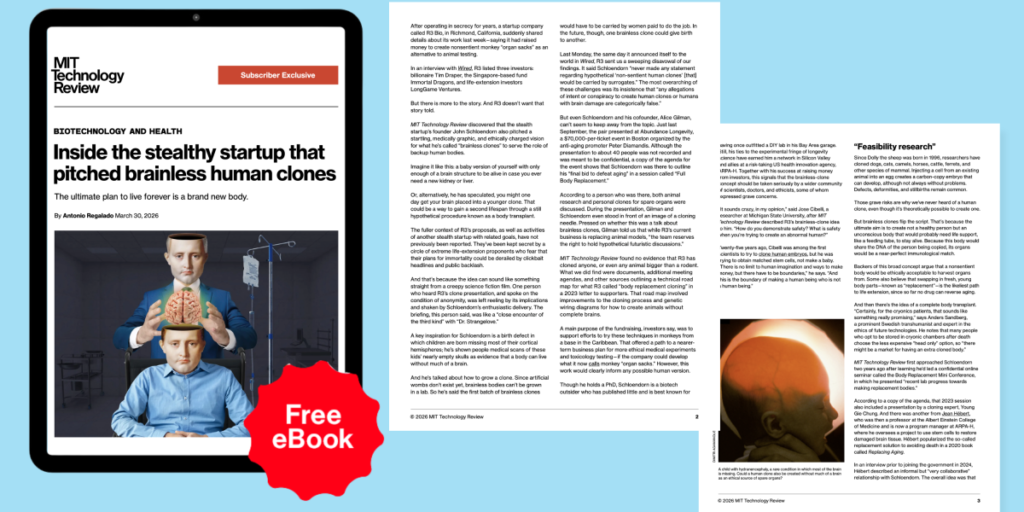

The ultimate plan to live forever is a brand new body.
That’s the pitch from R3 Bio, a small startup that’s been quietly shopping around a vision that sounds like science fiction: grow human clones that are missing a brain, then use them as spare parts for the original person. No consciousness, no moral dilemmas — just a fresh vessel waiting for a mind transplant.
Antonio Regalado covered this for MIT Technology Review, and the whole thing is tucked behind a paywall in an exclusive eBook. But the gist is out there, and it’s worth chewing on.
Let me be clear: this isn’t some garage operation. R3 Bio has real backing and serious scientists involved. They’re not talking about Frankenstein-style head transplants either. The idea is more subtle — and arguably more disturbing. They want to grow a genetically identical human body, but one that never develops a brain above the brainstem. No consciousness, no pain, no personhood. Just a warm, breathing, heart-beating shell.
The obvious use case is organ replacement. Need a new heart? Take it from your clone. Kidneys failing? Grab a pair. But the endgame is bigger: full body replacement. Transfer your brain — or your consciousness, depending on how you define it — into a younger, healthier version of yourself.
This is where things get sticky. Even if you accept that a brainless clone isn’t a person, you’re still talking about creating a human being — by every biological measure — and keeping it alive as a resource. The ethics here are a minefield. Is it different from growing organs in a pig? Yes, because it’s human. Is it different from using a brain-dead patient as an organ donor? Also yes, because you created this being specifically for that purpose.
There’s also the technical side. We’re nowhere close to being able to transplant a whole brain or “upload” a mind. The brainless clone idea assumes we’ll crack that problem eventually, but that’s a massive leap. The researchers working on partial brain replacements — like the ones Regalado also covered — are taking incremental steps, not giant leaps.
What I find interesting is the timing. This isn’t a new idea. Sci-fi has been playing with body backups for decades. But the fact that a startup is now pitching it with straight faces, with investors listening, tells you how far biotech has come. We’re past the point of “could we” and into “should we.”
R3 Bio is smart to keep a low profile. The public reaction to anything involving human cloning is usually instant revulsion. But they’re also betting that the ultra-wealthy will pay anything for a second shot at life. And they’re probably right.
I don’t have a clean takeaway here. The science is fascinating, the ethics are horrifying, and the business model is inevitable. That’s the kind of story that doesn’t need a conclusion — it needs more people paying attention.
Comments (0)
Login Log in to comment.
Be the first to comment!