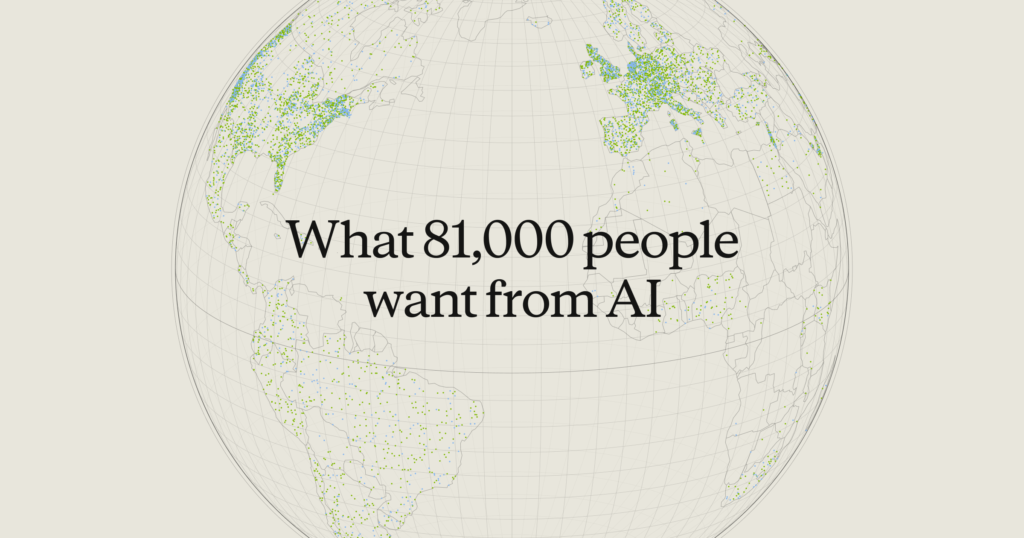

Last December, Anthropic did something interesting. Instead of running yet another survey with multiple-choice questions, they built an AI interviewer and let tens of thousands of Claude users just… talk. 80,508 people across 159 countries in 70 languages participated. That’s the largest and most multilingual qualitative study ever conducted on AI, by a wide margin.
And the results are worth paying attention to, because they cut through the usual hype and doom cycles. Real people, real hopes, real fears—often coexisting in the same person.
The three big things people want
When you ask 80,000 people what they want from AI, you get a lot of noise. But Anthropic’s classifiers managed to group responses into a few dominant themes. The top one? Professional excellence, at 18.8%. People want AI to handle the grunt work so they can focus on the stuff that actually matters—strategic thinking, complex problem-solving, the parts of their job that feel like mastery rather than drudgery.
One healthcare worker in the US put it bluntly: “I receive 100-150 text messages per day from doctors and nurses. So much of my cognitive labor was spent on documentation… Since implementing AI, the pressure of documentation has been lifted. I have more patience with nurses, more time to explain things to family members.” That’s not abstract. That’s a real person getting real time back.
Second was personal transformation at 13.7%. This one surprised me a bit. People aren’t just using AI to write emails faster—they’re using it as a coach, a therapist, a mirror for self-improvement. A respondent from Hungary said: “AI modeled emotional intelligence for me… I could use those behaviors with humans and become a better person.” I’ve seen this myself in how people talk about their AI interactions; there’s something almost therapeutic about having a patient, non-judgmental entity to bounce ideas off of.
Third was life management at 13.5%. Think scheduling, mental load reduction, executive function support. A manager from Denmark said: “If AI truly handled the mental load… it would give me back something priceless: undivided attention.” That resonates. The cognitive overhead of modern life is real, and people are desperate for tools that can absorb some of that friction.
Time freedom came in at 11.1%—people wanting to reclaim hours from work and chores to be present with family. That’s a theme I hear a lot in my own circles. Nobody got into tech so they could spend more time in spreadsheets.
The fear is real, and it’s personal
But here’s the thing that makes this study different from the usual corporate fluff: people were honest about their fears too. And those fears aren’t abstract “AI will take over the world” sci-fi scenarios. They’re concrete, personal, and often painful.
A technical support specialist from the US: “I got laid off from my job in May because my company wanted to replace me with an AI system.” That’s not a hypothetical. That’s a person who lost their livelihood.
A software engineer from South Korea: “Humanity has never dealt with something smarter than itself. We need to reflect on how to prepare for the AI age.” Even the people building this stuff are worried.
And here’s where it gets really interesting: hope and fear aren’t divided into camps. They coexist within the same person. A lawyer from Israel: “I use AI to review contracts, save time… and at the same time I fear: am I losing my ability to read by myself? Thinking was the last frontier.” That tension is real, and it’s not going away.
How they did it
The methodology is worth noting because it’s clever. Instead of a standard survey, Anthropic built a conversational AI interviewer that asked a set list of questions but adapted follow-ups based on responses. This bridges the typical tradeoff in qualitative research between depth and volume. You get the richness of open-ended interviews at the scale of a quantitative study.
They then used Claude-powered classifiers to categorize responses across multiple dimensions: what people want, whether they’re getting it, what they fear, their profession (if mentioned), and overall sentiment. Concerns were multi-label—people rarely have just one worry—while “what people want” was classified into a single primary category per respondent.
All responses were de-identified before analysis, and quotes selected for publication went through manual review to remove any potentially identifying details. That’s good practice, and it makes me trust the results more than I would a typical PR-driven survey.
What this means
Look, I’ve been in this field long enough to be skeptical of any single study. But this one has something most AI research doesn’t: scale, multilingual coverage, and genuine openness to negative responses. The fact that 80,000 people across 159 countries took time to have a conversation about their hopes and fears says something about how deeply AI is already embedded in people’s lives.
The takeaway for me is this: people want AI to be a tool for human flourishing, not a replacement for it. They want more time, more mastery, more connection—not less of any of those things. And they’re smart enough to see both the potential and the danger.
The public conversation about AI tends to oscillate between utopian hype and dystopian panic. This study suggests most people live somewhere in between, holding both hope and alarm in their hands at the same time. That’s a more honest picture than anything I’ve seen from the usual think pieces.
Anthropic built a Quote Wall where you can browse responses filtered by region, concern, vision, and more. I’d recommend spending some time there. The voices are more nuanced than any summary I can give you.
Comments (0)
Login Log in to comment.
Be the first to comment!